
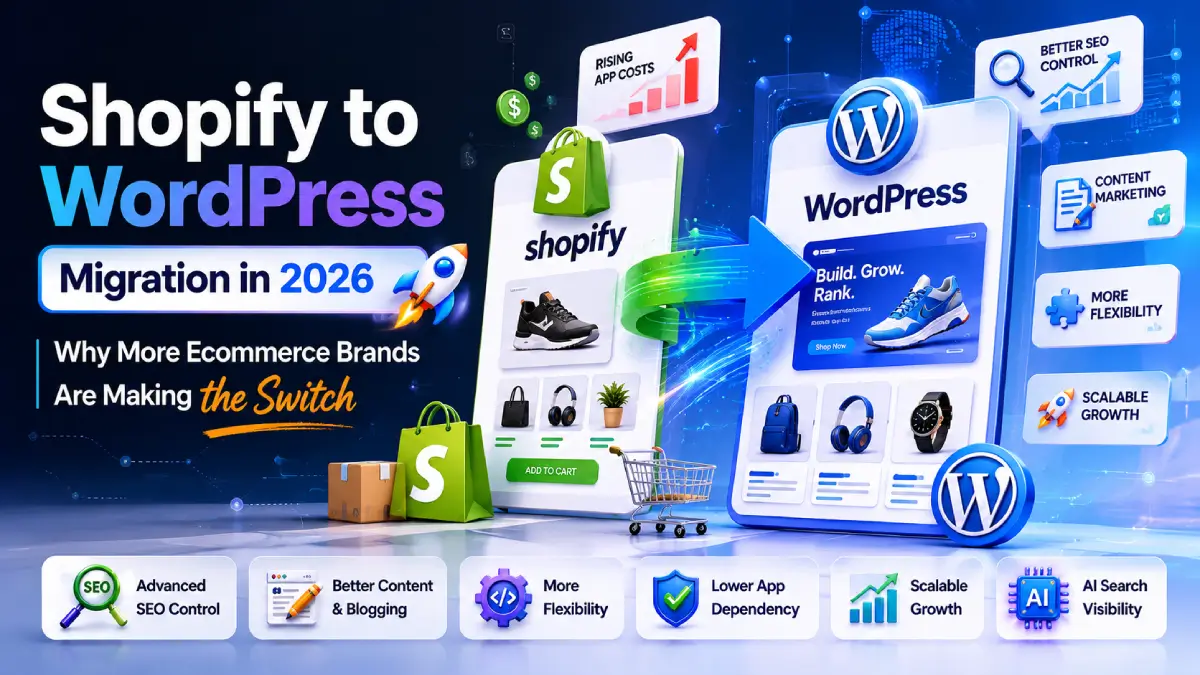
Shopify made ecommerce simple. That’s why so many businesses started there.
You could launch a store quickly, add products, install apps, and start selling without dealing with technical setup. For startups, dropshipping stores, and small brands, it was one of the easiest ways to get online.
But ecommerce in 2026 is different from what it was a few years ago.
Today, brands care more about:
- Organic traffic
- AI search visibility
- Content marketing
- Platform flexibility
- Rising app costs
- Long-term scalability
That’s why more businesses are now considering Shopify to WordPress migration.
Not because Shopify is bad.
But because growing ecommerce brands often need more control as they scale.
Why Businesses Start With Shopify
Shopify is still one of the best platforms for launching quickly.
It works well for:
- New ecommerce stores
- Dropshipping businesses
- Small product catalogs
- Founders without technical experience
Everything is managed for you:
- Hosting
- Security
- Checkout
- Store setup
For many businesses, that simplicity is exactly what they need in the beginning.
Why Businesses Move to WordPress Later
As stores grow, priorities change.
Most brands eventually want more than just product pages and paid ads.
They start investing in:
- SEO
- Content marketing
- Long-form blogs
- Organic traffic
- Better branding
- Custom functionality
This is where WordPress starts becoming attractive.
1. Better Content Flexibility
In 2026, ecommerce brands are acting more like publishers.
Brands now create:
- Buying guides
- Tutorials
- Product comparisons
- Educational content
- SEO landing pages
WordPress handles content much better than Shopify, especially for growing content-heavy stores.
2. More SEO Control
Shopify covers basic SEO well.
But WordPress gives more flexibility for:
- URL structures
- Schema markup
- Internal linking
- Category optimization
- Technical SEO settings
That matters more now because Google AI Overviews are rewarding deeper, well-structured content.
3. Rising App Costs
Many Shopify stores slowly become dependent on paid apps.
At first it feels manageable.
But over time businesses start paying monthly for:
- SEO tools
- Product filters
- Upsells
- Reviews
- Email marketing
- Advanced customization
Growing brands often want more ownership and fewer recurring platform costs.
Shopify vs WordPress for SEO
This isn’t really about which platform is “better.”
It’s about business goals.
Shopify works well if you want:
- Simplicity
- Fast setup
- Less maintenance
- Easy store management
WordPress works better if you want:
- Advanced SEO
- Content marketing
- More customization
- Flexible development
- Long-term scalability
For brands focused heavily on organic growth, WordPress usually offers more room to grow.
Can You Migrate Without Losing SEO?
Yes — if it’s done properly.
The biggest mistakes usually happen when:
- Redirects are ignored
- URLs change incorrectly
- Metadata gets lost
- Content disappears during migration
A proper Shopify to WooCommerce migration should preserve:
- Existing rankings
- Product pages
- Blog content
- SEO metadata
- Internal links
Some temporary ranking fluctuation is normal, but major traffic drops are usually caused by poor migration planning.
Common Reasons Brands Move Shopify Store to WordPress
Most migrations happen because businesses want:
- More SEO flexibility
- Better blogging tools
- Lower app dependency
- Advanced customization
- Better content ownership
- Scalable ecommerce infrastructure
Especially in 2026, where content and organic visibility matter more again.
Who Should Consider Shopify to WordPress Migration?
Migration makes sense for businesses that:
- Depend heavily on SEO
- Publish regular content
- Want more backend flexibility
- Need custom ecommerce features
- Are scaling aggressively
But not every store needs to move.
If Shopify is working well for your business, staying on Shopify is completely fine.
Final Thoughts
Shopify is still one of the best ecommerce platforms for getting started quickly.
But as businesses grow, many start needing:
- More flexibility
- Better content systems
- Stronger SEO control
- More scalable infrastructure
That’s why Shopify to WordPress migration has become a growing trend in 2026.
Not because Shopify failed.
But because growing brands often need a platform that gives them more control over how they scale, publish content, and build long-term organic visibility.
If your ecommerce strategy is becoming more content-driven and SEO-focused, WordPress is worth considering carefully.